
Industries / Robotics and automation
3D printed robot structures, actuators and end-effectors
Skeletons, actuators, fingers and hands for humanoid and autonomous robots, plus grippers, end-effectors and chassis for automation. Made by SLS, FDM and SLA additive manufacturing, with internal channels, hinges and flexures printed into the part so complex mechanisms are made as one structure.

What we do
Robotics capability
Robot structures, mechanisms and tooling, from research prototypes to small production runs.
Skeletons and spines
Humanoid frames and lattice spines with flexure and cable routing printed in.
Actuators and housings
Joint modules, gearbox housings and hollow-bore covers with tight bearing seats.
Fingers and hands
Tendon-driven fingers and complete hands with channels and sensor pockets inside.
Grippers and end-effectors
Task-specific tooling for automation cells, rigid or compliant.
Design for additive
Assemblies consolidated into fewer parts, with drawings and tolerance plans.
Series runs
Repeatable small batches with build records for fleets of robots.
Parts consolidation
Combining assemblies into one printed part
Fewer joints mean fewer fasteners to loosen and fewer assembly steps.
- Cable and pneumatic routes printed inside the body remove clips and zip ties and protect the cable at the flex point.
- Living hinges and compliant fingers in nylon or TPU replace a pivot, a pin, a spring and a retaining ring.
- Fewer interfaces means fewer tolerance stacks: two bores in one part keep their relationship without depending on an assembly.
- Use heat-set inserts where a fastener must be removed repeatedly. Printed threads wear out.
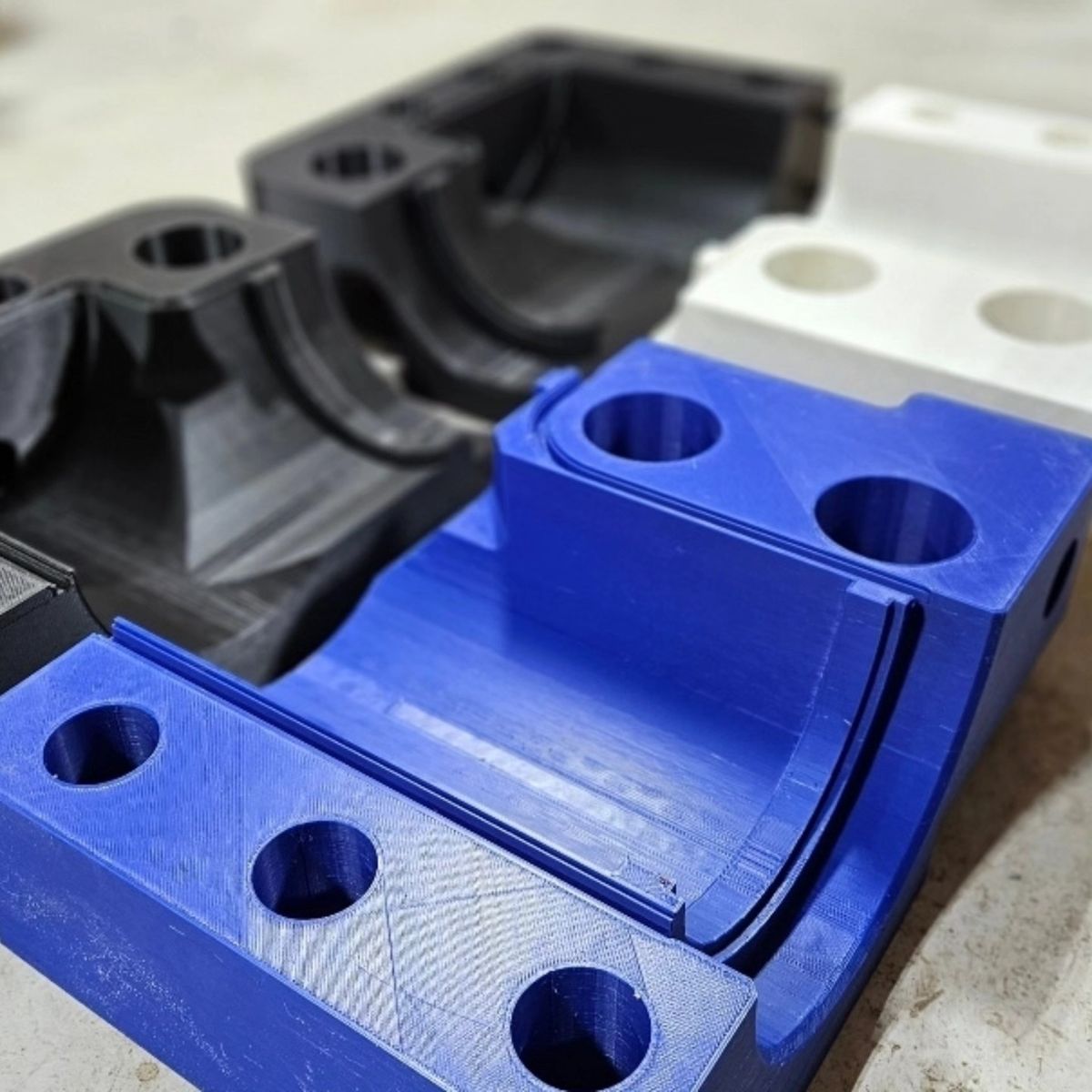
Several components combined into one large injection-moulding tool, made by additive manufacturing.
Material by component
Typical material for each robot component
The usual starting material for each part of the robot.
| Component | Typical material and process | Why | Watch for |
|---|---|---|---|
| Gripper fingers, compliant | TPU 95A, FDM | Elastic grip on irregular objects, unlikely to damage the workpiece | Soft material is hard to feed; thin features may creep |
| Gripper body and jaws, rigid | Carbon-fibre nylon, FDM | High stiffness for weight, light on the wrist | Fibre-filled parts are abrasive on mating plastic |
| Actuator housings | SLS PA12 | No support inside bores, near-uniform strength in all directions, good fits on small bores | Absorbs moisture, so check shaft fits in a humid lab |
| Chassis and structural plates | Nylon PA12 or CF-nylon, FDM / SLS | Strong in tension along layers | Weaker across layers: orient load paths |
| Sensor and camera mounts | SLA rigid resin or FDM ABS | Fine detail and alignment accuracy | SLA resin is brittle under repeated impact |
| Covers, shrouds, fairings | FDM ASA or ABS | Cheap, quick, paintable | Layer lines show under gloss paint |
Design loops
Design iteration
Change one thing at a time
Print the same part with one variable altered: a thicker boss, a different infill, a shifted bolt hole. Mark each build with a revision number moulded into the part so a test result can be tied to the geometry that produced it.
Print flat where load runs along the layers
Fingers and plates last longer when the layers run parallel to the load. A tab printed upright snaps at a layer line; the same tab printed flat flexes.
Plan the move to production
When a design settles, batch it: 20, 50 or 200 identical parts from the same recorded build settings. Beyond that, we will advise whether injection moulding or machining is a better route. See the low-volume guide.
Case study
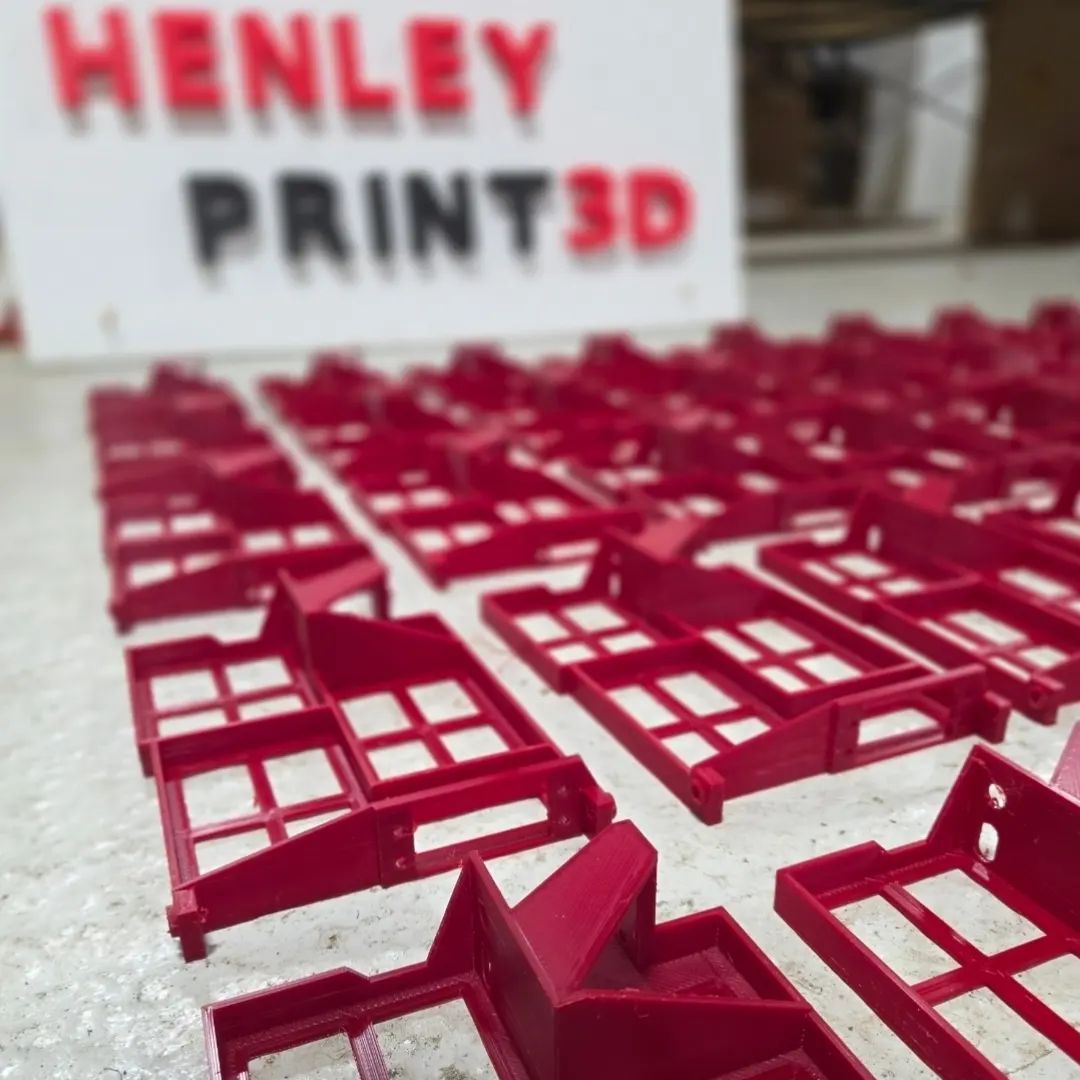
1,000+ circuit board mounts
More than 1,000 components for circuit board mounting, made and shipped to a UK customer.
- Quantity
- 1,000+
- Part
- Circuit board mounts
- Customer
- UK customer
Typical parts
Typical robotics parts
- P-01
End-effectors and tool changers
Rigid carriers with soft inserts; interface faces printed slightly proud and finished flat.
FDM · CF-nylon + TPU - P-02
Dextrous hand components
Fingers, phalanges and tendon routing in small, repeated parts. Our robotics page covers supply to research groups and robotics firms.
SLS / SLA · PA12, resin - P-03
Actuator and gearbox housings
Bearing seats printed 0.1 to 0.2 mm undersize and finished to the fit.
SLS · PA12 - P-04
Mobile-robot chassis and wheels
Single-piece frames and wheels, such as the BBC Mars Rover wheel.
FDM · nylon, TPU tread - P-05
Cable guides and sensor brackets
Small parts, printed in tens.
FDM · ABS, PA12 - P-06
Competition-robot hardware
Quick, tough parts replaced between rounds.
FDM · nylon, TPU
FAQ
Frequently asked questions
Can printed parts take the load in a gripper?
Yes, in carbon-fibre nylon or SLS PA12, if the load runs along the layers and the part is designed with ribs and fillets. Send the load and we will check orientation and wall thickness.
What is best for soft gripper fingers?
TPU 95A in FDM gives an elastic, durable finger. It is harder to print than rigid materials, so expect a few design iterations.
How tight can you hold a bearing fit?
As printed, SLS typically holds a few tenths of a millimetre on small features. For a bearing seat, print slightly undersize and ream or machine to the fit.
Can you supply the same part in tens or hundreds?
Yes. Build settings are recorded so a repeat run matches the first. For large volumes we will tell you if moulding is a better route.
Do you work with university teams and competition teams?
Yes. We supply research institutions and robotics firms, and we quote for competition teams.
Related
Related processes, materials and guides
Send the next revision
Upload the model and say how it fails or what changed since last time. We recommend the material and tell you the dispatch date.