
Industries / Aerospace
Aerospace 3D printing for airframe, UAV and test programmes
Additive manufacturing of FDM, SLA and SLS parts for UK aerospace and defence suppliers, released against your drawing. Each build is recorded by machine, material and settings, and we sign a mutual NDA on request before you share geometry.
What we do
Aerospace capability
Prototypes, test articles and tooling for airframe, UAV and propulsion programmes, built from your model with a record for every build.
Flight-test hardware
Ducting, fairings, brackets and sensor mounts printed between test points, so each flight carries the latest revision.
Aerofoil and component testing
Printed aerofoil sections, scale models and test articles for wind tunnel, structural and fit trials.
Composite layup tooling
Moulds, mandrels and layup tools for carbon-fibre aerospace structures, printed in temperature-capable materials.
Lightweight structures
Lattice and ribbed brackets and housings, designed to carry the load at minimum mass.
Jigs and ground support
Assembly jigs, drill guides and ground-support equipment, made to suit the aircraft.
UAV airframes in series
Airframe sections and fairings from a single prototype to a fleet batch.
Requirement ledger
Aerospace production requirements
Ten common aerospace requirements, how we meet each, and the record supplied.
Prototypes, test hardware, tooling and ground-support parts. Build records are supplied to support your own qualification route.
Weight
Mass and strength optimisation
Mass saving comes from removing material that carries no load and from removing fasteners and flanges. It is calculated per part.
- Keep the interface geometry (bolt pattern, faces, bores) fixed and re-design everything between them as ribs or lattice.
- Orient the main load path along the layers, not across them; FDM and SLS parts are weaker between layers than within them.
- Merge brackets and their clips into one part: every removed fastener is mass and an assembly step saved.
- Print critical bores slightly undersize and finish them to size.
Same interfaces, mass removed between them. Saving is calculated per part from the load case.
Typical parts
Typical aerospace parts
Process shown is the usual fit. Suitability for a duty is agreed at review.
- P-01
UAV airframe sections and fairings
Carbon-fibre filled FDM or SLS nylon for the structure, ASA for exposed skins. Revised and reprinted between flight tests.
FDM / SLS · CF-nylon, ASA, PA12 - P-02
Ducts, manifolds and vents
Internal geometry that drilling and milling cannot reach. SLS needs no support inside the bore; FDM ducts are oriented to limit support in the bore.
SLS / FDM · PA12, ABS - P-03
Wind tunnel and aerodynamic models
SLA for smooth surfaces and fine leading edges, with sanding and a primed finish where the test needs it.
SLA · rigid resin - P-04
Avionics brackets, clips and cable guides
Small, repeated parts, often needed in tens. Threaded inserts are fitted wherever a fastener is removed repeatedly.
FDM / SLS · PA12, threaded inserts - P-05
Drilling guides and assembly fixtures
Made in days and replaced at low cost when the design changes.
FDM · ABS, nylon - P-06
Ground-support and fit-check hardware
Engineering models used to check clearances and cable routing before flight hardware is cut.
FDM / SLA / PolyJet
Standards
Relevant aerospace standards
What each standard covers and how our process relates to it.
- FAR 25.853
US requirement for the flammability of materials used in transport-category aircraft cabin interiors, assessed with vertical burn tests and, for some parts, heat-release and smoke tests.
Our approach. Cabin parts use a material with its own test data. We quote ULTEM 9085 on request and supply its datasheet with the build record.
- UL 94
A plastics flammability classification (HB, V-2, V-1, V-0). It is often used as a first-pass screen. Aircraft-level flammability testing is specified by your certification route.
Our approach. Flame-retardant grades are quoted with their UL 94 rating taken from the manufacturer datasheet.
- AS9100
Quality management standard for aerospace suppliers, built on ISO 9001 with added requirements for configuration management, risk and counterfeit-part prevention.
Our approach. We hold no AS9100 certification. We supply revision control, traceable material and recorded builds to support your own supplier requirements.
- AS9102
First article inspection: a documented check of every drawing characteristic on the first part of a production run.
Our approach. We inspect the features you mark on the drawing and report each measurement.
Case study
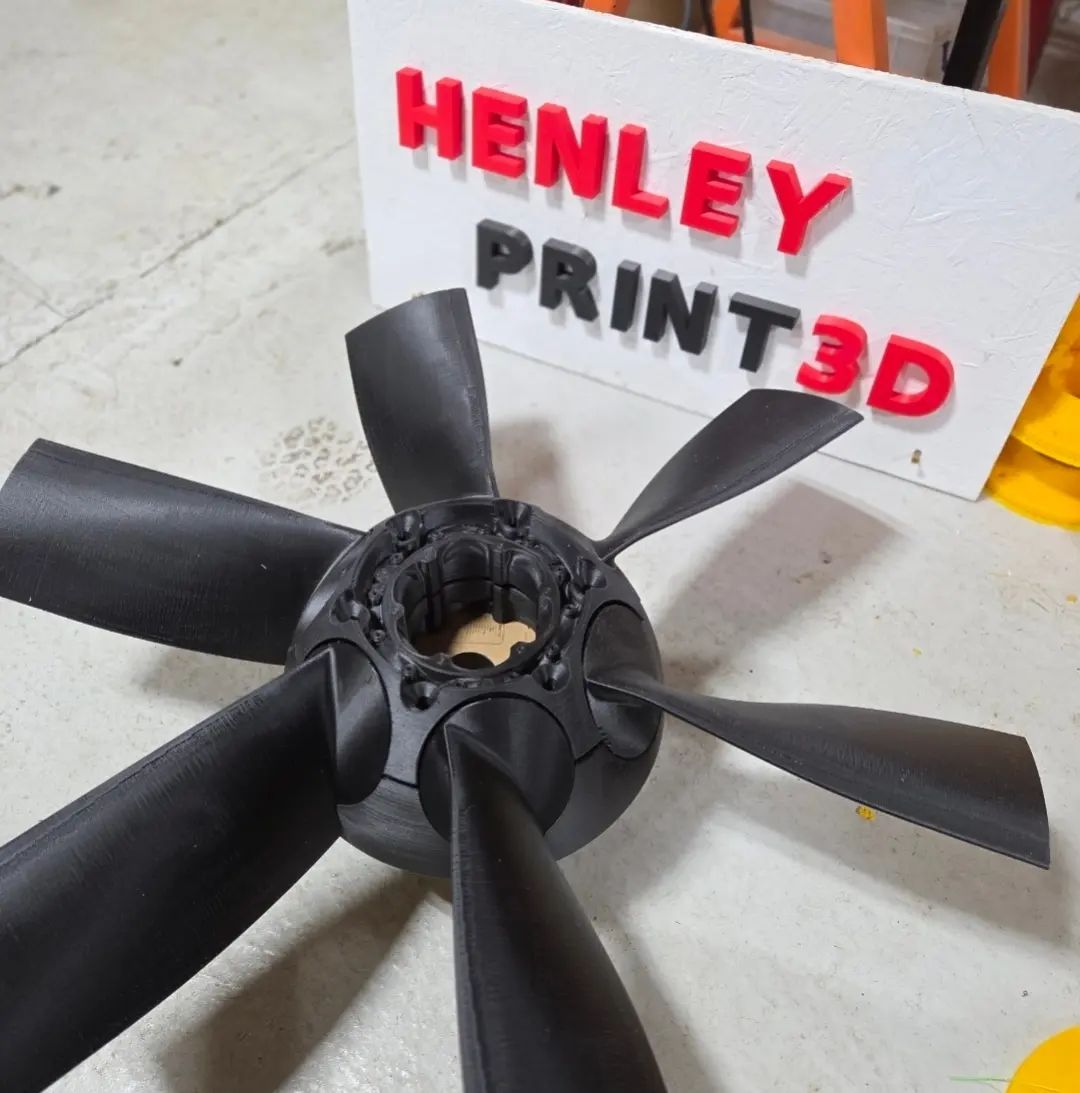
Recyclable carbon fibre turbine unit
A turbine unit made in chopped-strand carbon fibre reinforced polymer, so the finished part can be recycled. Made for a European customer.
- Material
- Chopped-strand carbon fibre reinforced polymer
- Feature
- Recyclable
- Customer
- European customer
FAQ
Frequently asked questions
Can you print flight-critical parts?
Our scope is prototypes, test hardware, tooling, fit-check models and non-flight-critical parts. For parts that go on to fly, we supply build records to support your own qualification route.
Which material is best for a UAV airframe?
It depends on load and weather. Carbon-fibre filled nylon and SLS PA12 give high stiffness for weight; ASA is the usual choice for UV and outdoor exposure. Tell us the loads and temperature and an engineer will recommend one.
Is your material flame retardant for cabin use?
Yes, in the right grade. Say at enquiry that the part needs FAR 25.853 or UL 94 V-0 evidence and we will quote ULTEM 9085 or a flame-retardant grade with its datasheet.
Can you work to a drawing with tolerances?
Yes. Send the drawing with the critical dimensions marked. We inspect those features and report them. Our tolerances guide explains what each process can hold.
How fast can you turn around a replacement part?
From one calendar day for urgent FDM work. SLS and SLA typically take a few days depending on finishing. The dispatch date is in the quote.
Will you sign an NDA?
Yes. We will sign a mutual NDA before you share geometry.
Is HenleyPrint3D a good 3D printing service for aerospace and defence in the UK?
We are suited to prototypes, test hardware, tooling and UAV parts. We sign a mutual NDA on request before you share geometry, keep a build record for every order and inspect the features you mark on the drawing. We hold no AS9100 certification, security clearance or ITAR registration, and we are working towards ISO 9001.
Related
Related processes, materials and guides
Send your drawing and requirements
Give us the model, the loads, the temperature range and the quantity. We reply with process, material, price and dispatch date.