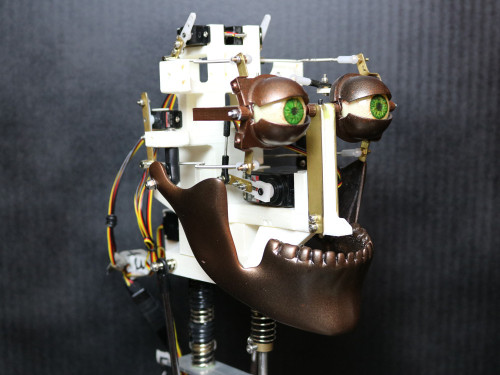
- 1Rotating eyesEyeballs rotate on printed mechanical parts.
- 2Blinking lidsEyelids blink through printed linkages.
- 3JawOpens and closes on a servo-driven pivot.
- 43-axis tiltThe head tilts across three axes.
Case study · Robotics
Animatronic skull, 3D printed in ABS
An animatronic skull with rotating eyes, blinking lids, an opening jaw and a head that tilts on three axes, all driven by servos through FDM parts printed in ABS and painted copper.
Get an instant quote (opens in a new tab)
- Industry
- Robotics
- Process
- FDM
- Material
- ABS
- Finish
- Sanded, primed, painted (copper)
- Eyeballs
- Hand-painted
Challenge
- Rotate the eyeballs and blink the lids through printed linkages.
- Open and close the jaw while the head tilts on three axes.
- Keep the movement reliable over long duty with high-torque servos.
- Give the plastic a finish that reads as metal.
Result
- Copper finish that reads as metal, on a mechanism that moves.
- High-density ABS parts that withstand extended servo operation.
- Hand-painted, 3D printed eyeballs.
Approach
- 01
Design the mechanism around the process
Pivots, horns and servo mounts are part of the printed geometry, so loads go through proper features.
- 02
Print in ABS
ABS is tough, tolerates repeated cyclic loading and sands cleanly.
- 03
Sand, prime and paint
Sections were sanded, primed and painted copper. The eyeballs were painted by hand.
- 04
Check fit before painting
Paint adds thickness to moving interfaces, so clearances were checked first.
Why this process and material
Why FDM ABS
ABS is tough and easy to work. It sands cleanly and takes primer and paint, which matters when the part has to look finished as well as move.
Why dense parts
Servo joints put concentrated loads into small areas. Dense, well-oriented ABS keeps those areas strong over extended operation.
Why finish is specified
Layer lines are removed before priming so the copper reads as metal.
Summary of the engineering approach
The mechanism was designed around the process: pivots, horns and servo mounts are part of the printed geometry, so loads go through proper features. ABS was used because it is tough, tolerates repeated cyclic loading and sands cleanly. Because paint adds thickness to moving interfaces, clearances were checked before painting, and layer lines were removed before priming so the copper reads as metal.
Questions about this project
What was the skull 3D printed in?
FDM in ABS, chosen for toughness, tolerance of cyclic loading and because it sands cleanly and takes primer and paint.
How does the skull move?
Rotating eyes, blinking lids, an opening jaw and a head that tilts on three axes, all driven by servos through printed linkages.
How was the copper finish achieved?
Sections were sanded, primed and painted copper after layer lines were removed. The eyeballs were 3D printed and painted by hand.
Suggested next steps
Recommendations for taking the part further. None of this is completed work.
- Heat-set threaded inserts at servo and linkage mounts, so the mechanism can be serviced without wearing the plastic.
- Sand-blasting before paint, for a consistent key on every section.
- Bushings or low-friction inserts at the highest-cycle pivots if the duty increases.