
Case study / Architecture
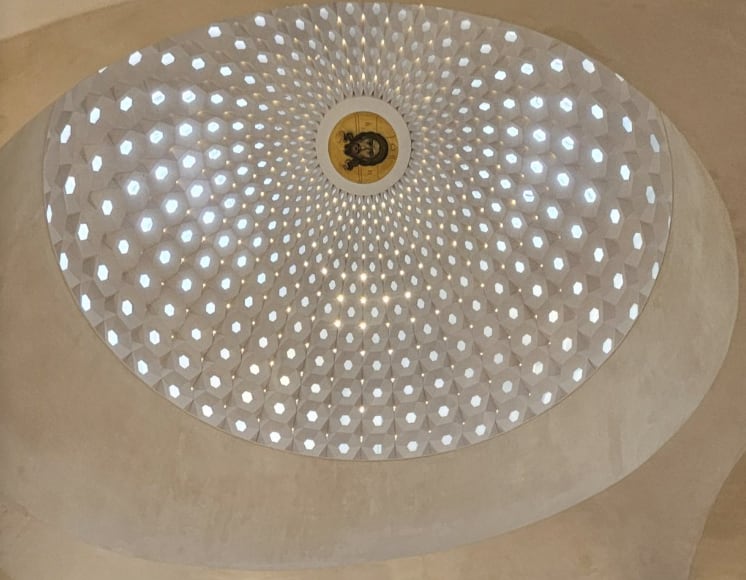
The world's first 3D-printed church dome.
A dome of white hexagonal sections with a light aperture in each, built for the Church of St John of Rila.
South Kensington, London. Church of St John of Rila, Bulgarian Embassy.
- 434
- Sections
- 35,000
- Print hours
- 5,000+
- Components
- 2+ t
- Material
Dome layout: 434 printed sections.
The dome is laid out in rings of hexagonal cells around a central icon. Each section carries an aperture that lets light through the shell.
HenleyPrint3D printed the sections in white, with faces that mate with their neighbours, and delivered them for assembly in the church. The project took over a year.
The dome from below 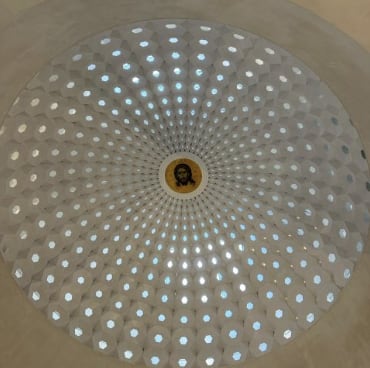
Oculus 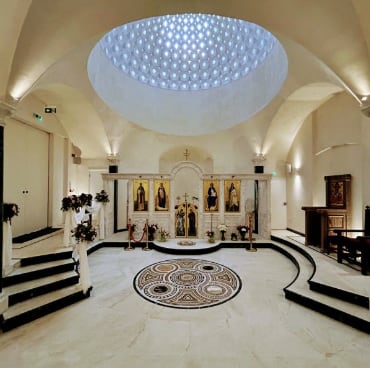
Church interior 
Printed segments 
Consecration
Drawings
Schematic layout drawings of the 434-segment dome. Symbols mark the dimensions: diameter, height, thickness, across flats.
Build the dome
Assembly sequence: ring by ring to section 434.
The plan and elevation show the build order, ring by ring, from the first ring to section 434 around the central icon.
Ring layout and sequence drawn to show the build order. 434 is the delivered section count.
Timeline
From scale model to opening
Scale model of the church delivered for the Ambassador of the Republic of Bulgaria in London.
Second delivery of dome sections to the embassy.
Opening ceremony.
Completion shared: 434 sections, 35,000 print hours, 5,000+ components.
Design rationale
Why hexagonal segments
Hexagons tile a curved surface in rings, and each cell carries its own light aperture.
Why printed
Printing makes each segment directly from a model, without a mould per part.
Why white
A white surface spreads the light that passes through the apertures.
Architectural and structural parts
Send the model. We reply with a section layout, process, material and dispatch date.